Everything is a technology these days. Skin care is a technology. Meditation is a technology. A notebook is a technology. GPS is a technology. The word is broad! Apparently in the 70s the word was practice - and everything was a practice -today everything is a technology. In the 80s/50s - Grease was the word (that was a joke).
As a once and future ‘technologist’ this word has a particular meaning to me and I think about what it means that everything is a technology now.
The Right Not to Be a Technology grew out of the ISCI fellowship I attended with Ariella Azoulay and her notion of “the right not to be a perpetrator.” The language of rights returns us to an Enlightenment faith that society can be ordered through laws—that if we can only establish the proper rights and obligations, we will govern ourselves more justly. But who is the “we” that writes those laws? Not everyone for sure. Many people are excluded from the “we” which is one of the problems of liberalism.
Azoulay often locates this critique in the camera. The shutter is not a neutral instrument; it is an operation that cuts, catalogs, isolates, and participates in imperial ways of seeing.
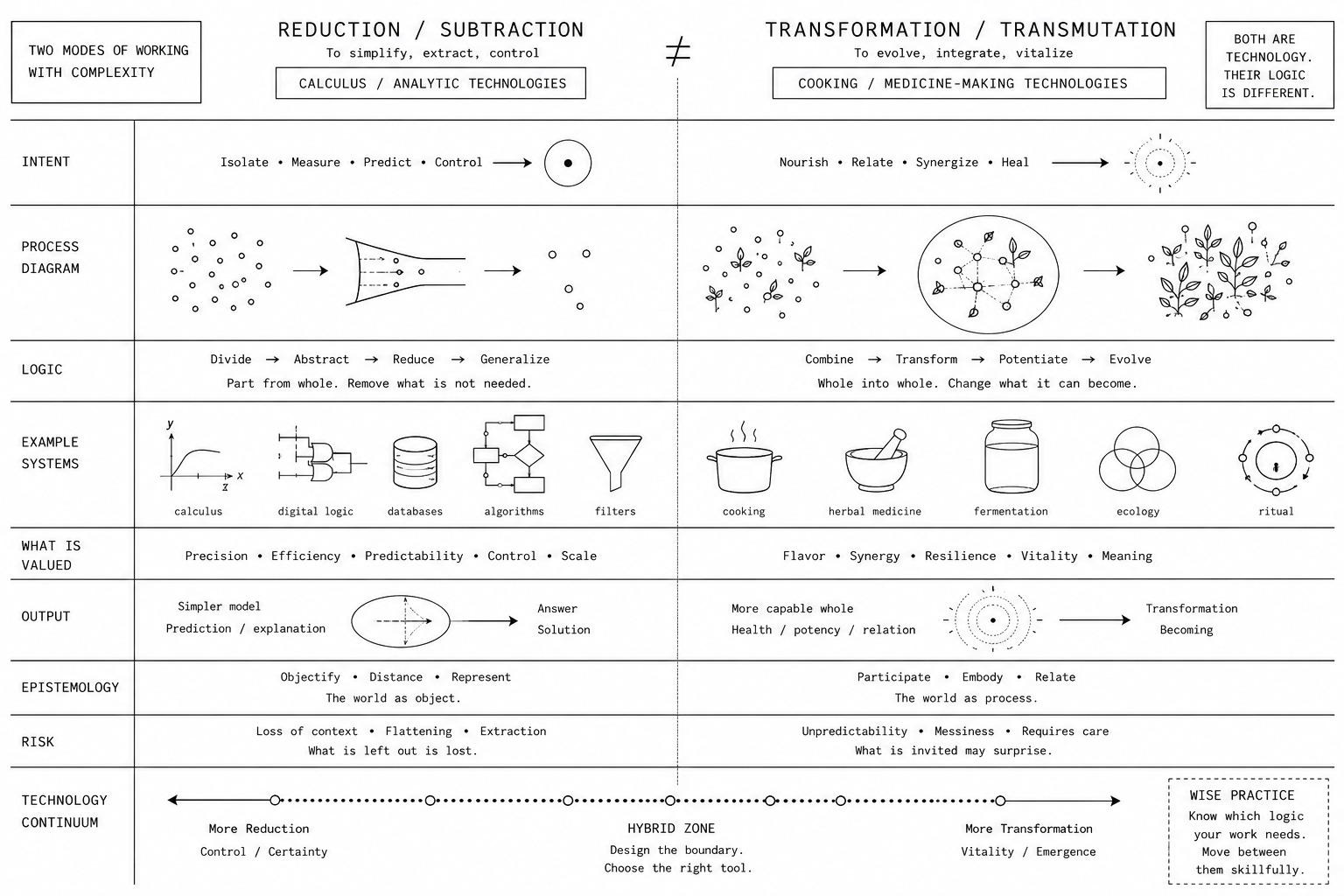
The technologies I work with historically are digital. They are technologies of reduction. Not simply because computers operate in binary, but because they make the world computable/decidable. They transform continuities into discrete values - this is their architecture.
I have been writing about the genealogy of the Artificial Intelligence and Large Language Models computer through statistics and probability: statistics emerging alongside the administrative nation-state, probability emerging from financial capital - and both emerging from eugenics. These are technologies that make inferences by reducing complexity.
As an herbalist the technologies I work with feel fundamentally different. I use a stove, a dehydrator, a Soxhlet extractor, sometimes a blender. They are tools, and they are hardly innocent—any of them can be implicated in systems of extraction or empire—but they do not reduce a plant to bits and bytes. They amplify processes already within the material itself: heat, time, water, alcohol, attention. They are extensive rather than reductive.
This refers to a philosophy of technology and a post-phenomenology and Don Ihde among others.
Obviously these are not all the same types of technologies. Some technologies close possibilities by compressing the world into representations that can be computed. Others open possibilities by increasing the ways we can interact with the world.
I am probably not going to stop using computers or AI for now, but I do want to reclaim some of my practices from the realm of technology. I want a richer vocabulary that distinguishing between activities that reduce the world and those that deepen our participation in it.
Hence the right not to be a technology - and that goes for the human being as well.