
It's Saturday night where I am, and I'm reading “A Feast In the Time of a Plague”
How do we explore different personas? Probably one of the original art forms to do this is theater. This is the exploration of persona in public. It is the exploration of personas with a witness. Why is this important? Perhaps to create a collective definition of what certain personas are, to create standard values for a culture regarding which personas are valuable, useful, or how different personas function within a certain value system (i.e., culture)
A Feast In the Time of a Plague by Pushkin Translated by Yankelevich
I am reading a beautiful translation of Pushkin’s “A Feast In the Time of Plague” translated by Matvei Yankelevich and published by Ugly Duckling Press. It is beautiful in the language and in the production. I once at the NY Art Book Fair, complemented a bookseller on his beautiful book, to which appeared insulted and then he accused me of being bourgeois (which I am). I like beautiful things. If no everyone shares that value, I am ok with that. This translation is beautiful on all levels. The end pages discuss the printing process and the discussion of font selection, and where else you might see this font. Really this is decadent in the most incredible way. Perhaps I am not bourgeois - I am decadent.
To Feast in a Time of Plague is Decadent
Pushkin wrote this piece while he was waiting out a plague -Cholera. Unlike, me, he was incredibly prolific creating great works of art during his three month quarantine. He really life hacked that plague. The work is a play, a really short play. I hesitate to even call it a play. It could be a ritual. The seven characters are pretty archetypal - they are PERSONAS. We don’t know much about them, they are not really developed. I hope there really are seven characters. I don’t have the play in front of me and I am going to go on a riff about the number seven: seven days in the week, seven planets, seven chakras.
The Work
Pushkin’s piece was itself originally a rewrite or translation of the first act of John Wilson’s The City of A Plague. This is why there are many references to ‘Scottish’ in the work, which I did find a bit confusing at first. John Wilson was a contemporary of poets Coleridge and de Quincey, Romantic poets, who could probably be considered decadent since they lounge around in Opium Dens, although the critics define some other later poets as decadent. The work is also constantly being rewritten through performances and reinterpretations as plays.
What is a rewrite vs a reinterpretation?
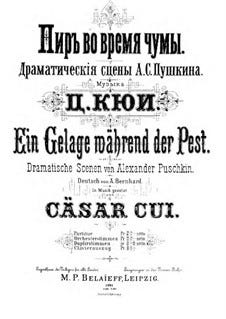
This image is from musicneo.
I feel I should say a little about the work. People come, people go, people talk about death, people see dead people, there is a song, a musical number. As I read the play I imagined an animated piece by William Kentridge perhaps, I imagined a musical number by Monty Python, I imagined some ink drawings. The writing of personas set my imagination on fire.
Thanks for reading!
much love
Meredith