
Explorations in Governance
Technology and Necropolitics

For quite some time now, I’ve found myself entangled in the world of governance—a term I used to associate solely with elected officials and public institutions. But lately, governance is everywhere. It’s in the corporate corridors of AI Governance, Software Governance, and Data Governance, and it is critical to DAO governance, which is essentially the codification of organizational decision-making.
From Laws to Policing
I have a theory. As technology saturates every aspect of everyday life—what Jacques Ellul famously called la société technicienne, or the technological society—we are no longer ruled by law in the classical sense. The laws are a given; they are the algorithm. And instead, the focus is on enforcing the law—i.e., on policing.
The bulk of our energy is now spent enforcing rules (often opaque, automated, or baked into design patterns), rather than deciding what those rules are in the first place.
Metrics-as-Reality
This shift feels entangled with what I can only describe as the Business Intelligencification of the world—the transformation of everything into metrics. Clicks per minute. Completion rates. Disparity indices. ROI matrices.
We’ve entered a strange, recursive terrain where:
We collect massive datasets (”the more the merrier”),
Those datasets generate a model of the world—a second-order reality,
Then we govern that model rather than the world.
In other words: first you build a giant simulacrum out of numbers. Then you police it.
Humans, for now, are still asked to “sign off”—to rubber-stamp decisions made by algorithms.
What we originally called politics, “the affairs of the city,” has become a virtual politics, “the affairs of a model of the city.”
From Politics to Biopolitics to Necropolitics
As I sit with all this, I can’t help but draw connections to the texts I’m reading. First amongst them: Achille Mbembe’s Necropolitics.
Michel Foucault taught us that modern power governs through the regulation of bodies (biopolitics). Mbembe expands to say that modern power governs not how we live, but who is allowed to live. Necropolitics is governance through the power of death (necro), not life.
In this frame, political critique shifts:
From class and labor distribution,
To the fundamental divide between the living and the disposable.
Technology and Politics
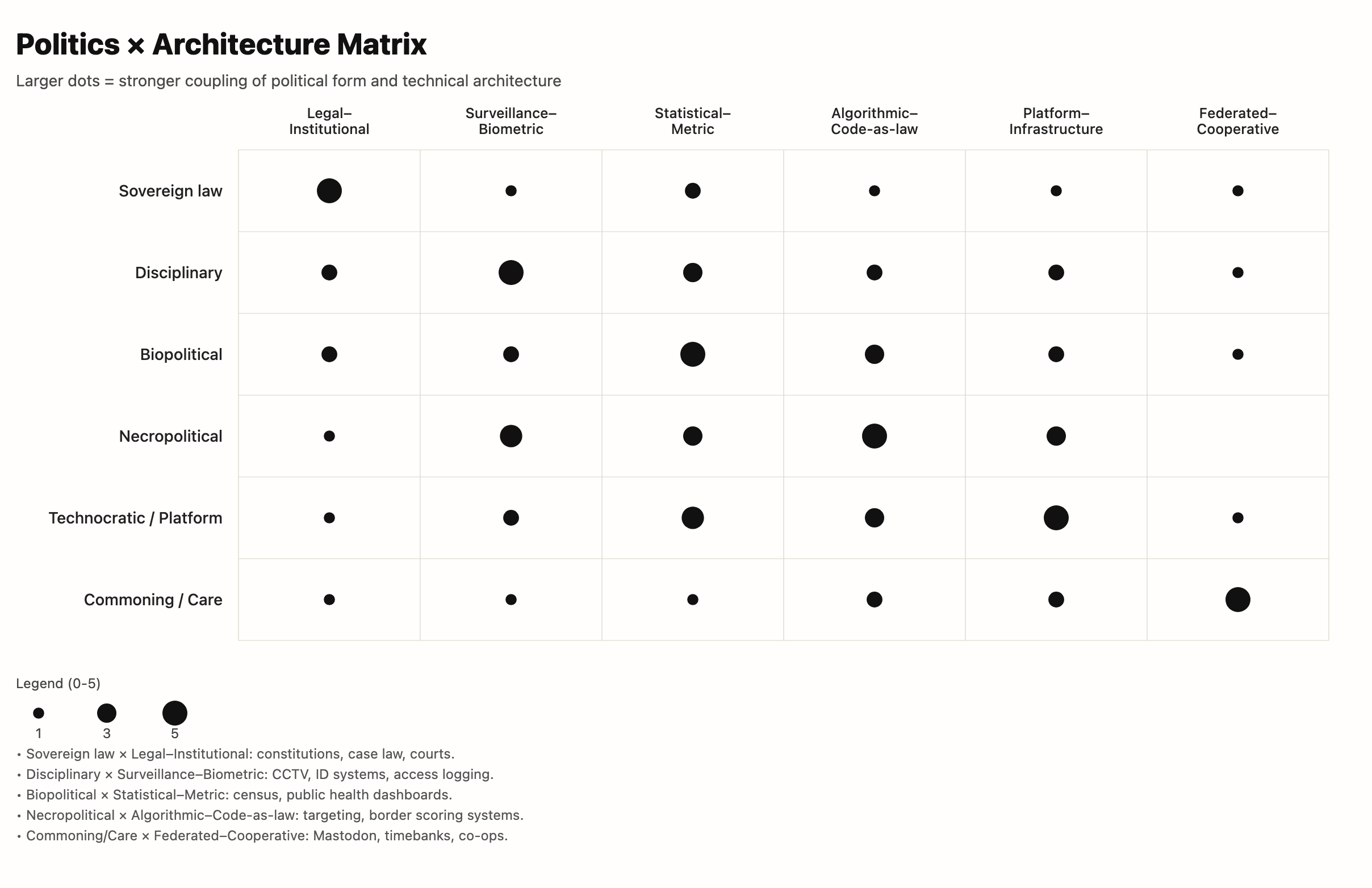
It is through architecture that biopolitics became possible: the factory, the school, the camp, the prison, the gym. However, it is only through technology that a necropolitics is possible.
Surveillance systems that identify,
Drones and weapons that nullify borders
Algorithmic classifications that identify which bodies are allowed to live and which are not
The Animist Twist
However, technology also reintroduces animism into the neoliberal order. “Inanimate” objects—algorithms, sensors, dashboards—are imbued with agency. They act. They decide.
Technology becomes the organ of a new metaphysics: remaking the line between who counts as animate and who is rendered inert.
In the ongoing effort to re-enchant the world and listen to nature —to return to this form of animism —there is also the temptation to believe that our technology speaks to us more than nature does.
Toward a Living Governance
For larger organizations built on distributed decision-making, the task is to understand how governance cultivates life rather than death, and
an appreciation of what is rather than a simulacrum.
Governance doesn’t have to be the architecture of necropolitics. It can be the choreography of care.
Code Experiments
There is a governance code simulation over at https://thewitchofendor.com/ and https://eon-meridian.github.io/eon.github.io.
Next AI Satsang Tuesday Nov 15th
Register at https://us06web.zoom.us/meeting/register/0_QIM_HiShKbX3To2JnVCQ
Wow, totally nailed the whole metrics-as-reality thing. So important, thanks!