
Terence McKenna was an ethnobotanist, mystic, and author, best known for his theories about consciousness and psychedelics - that humans evolved those qualities we associate with being human, like language, from eating psychedelic mushrooms on the African Savannah.
I randomly started listening to a lecture he recorded on alchemy, and just dove in. This is what I found.
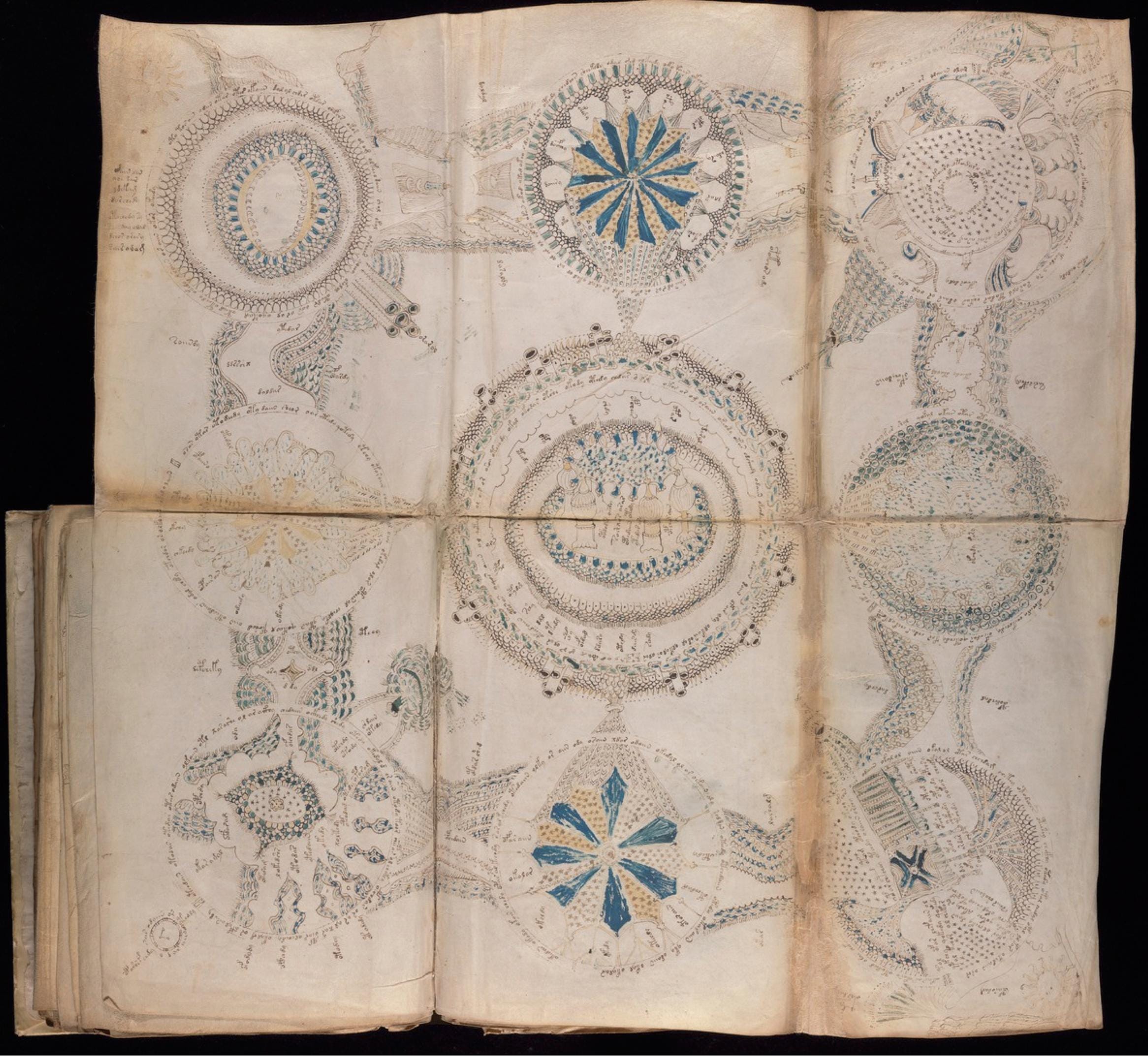
I listened to this episode first. McKenna ranges widely across subjects and reframes alchemy as a spiritual technology of human transformation, connecting it to Jungian psychology and to heretical Christian sects like the Cathars. The highlight was his digression on the Voynich Manuscript: a mysterious, undeciphered text that may encode a Cathar herbal sacrament. McKenna suggests it’s a lost ritual manual—but the real story is even stranger. As an herbalist, this digression integrated my experience with plants as material healers and as spiritual healers, and really, the entire episode felt like it was dissolving the division between matter and spirit.
I hadn’t meant to listen to this episode; it autoplayed while I slept on the train. McKenna’s voice reading Finnegans Wake felt like a spell. I woke up with a new sense of how art transforms consciousness—and how language can build entire cities of meaning.
Episode 706 Terence McKenna One Last Timewave Rap
So here we are, talking about the Eschaton—the end of the world. In Robert Anton Wilson and Robert Shea’s The Illuminatus! Trilogy, a shadowy cabal wants to “Immanentize the Eschaton,” a phrase I’d long associated with a countercultural, free-love rebellion. But I recently learned the term originated with conservative William F. Buckley, who used it to critique utopian impulses—suggesting the phrase itself holds a dual edge: destruction or radical transformation.
I reference all this because this McKenna episode is about the Eschaton—in 2012. It didn’t happen, I don’t think, which raises the question: what does a failed prophecy mean for the prophet?
In this episode, McKenna offers the I Ching as a temporal instrument—as if time has qualitative contours we’ve never learned to read. He suggests we lack tools to measure the texture of a moment in time, as physicists do with space-time curvature.
He loops in the Stoned Ape theory, wondering if mushrooms are accelerating consciousness in anticipation of a cosmic event—like a quasar ready to drench us in radiation. I found myself fixated on the I Ching—what would it mean to design a sensor for time’s qualities, not just its quantity?
I’ve listened to more than three of McKenna’s talks now, but these stand out as my favorites—and I’m pretty sure they were all recorded at Esalen. It feels fitting. Esalen is where so many experiments in human potential began or found a home. Really, all these concepts are just models, or containers, for our own embodied awakening.